Why Your Lawn Has Brown Spots (And How Pros Fix It)
Brown spots on your lawn usually mean uneven watering, not just “too little.” Here’s how irrigation pros diagnose the real problem and fix it for good.
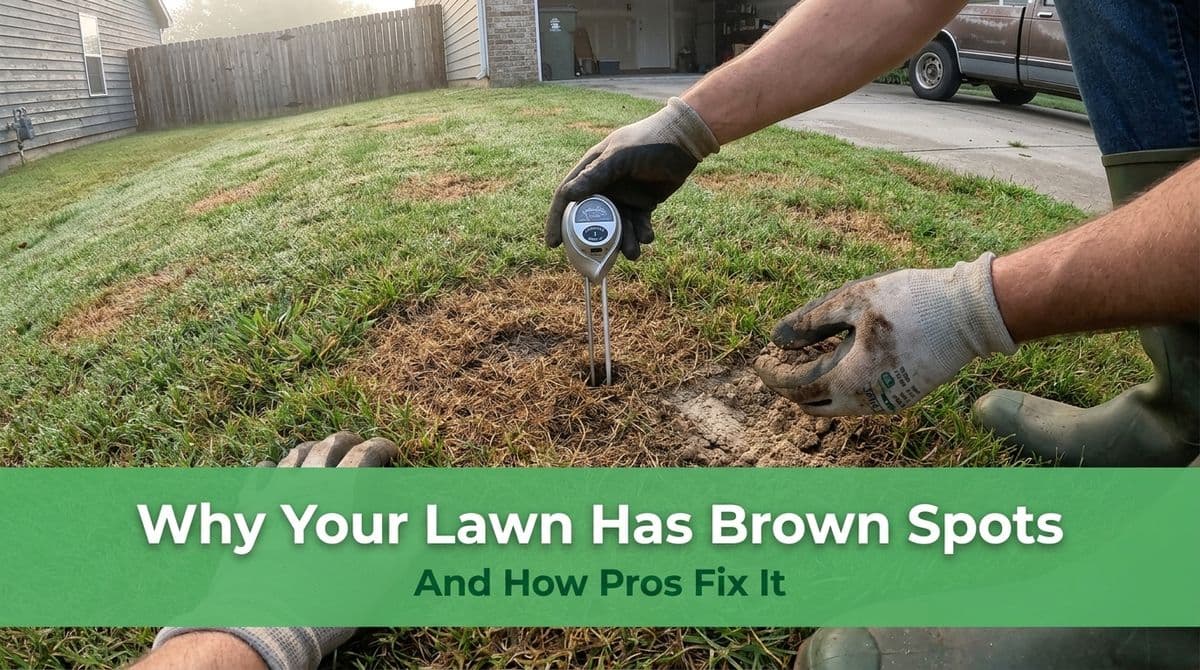
Brown Spots on Your Lawn? Here’s How We Track Down the Real Irrigation Problem
We recently got a call from a customer — let’s call her Lisa — who had three things bugging her in the yard. In the front, a hose faucet was leaking. In the back, she wanted to convert a capped sprinkler head to drip for her plants. And all over the lawn, she was seeing those dreaded brown spots and wanted us to “look at all of the sprinkler heads and fix or adjust them as needed.”
She also mentioned something very important: she already knew there were problems with at least two heads in the backyard because they were “only spraying out a little tiny bit,” while the front lawn just looked patchy and tired without an obvious broken head. That mix of symptoms is exactly what we run into all the time — and it’s a perfect example of how we, as irrigation pros, diagnose and fix brown spots.
Why Brown Spots Don’t Always Mean “Water More”
Most people see brown patches and immediately think, “My sprinklers must not be running enough.” Sometimes that’s true, but just as often the schedule is fine — it’s the distribution that’s the problem.
With Lisa, we suspected two different issues:
- Obvious under-spray from those backyard heads that were only throwing a tiny bit of water.
- Subtle coverage gaps in the front where everything “looked” like it was working, but the lawn was still browning in patches.
Grass doesn’t care how long your system runs; it cares how evenly water is getting to the roots. A few common culprits we see:
- Partially clogged nozzles
- Leaking or sunken sprinkler heads
- Mismatched nozzles or poorly aimed heads
- Low pressure zones on one part of the system
How We Diagnose Brown Spots Like a Pro
When we show up to a yard like Lisa’s, we don’t start by turning up the minutes on the controller. We start by walking the system.
Step 1: Run Each Zone, One at a Time
We’ll put the controller into manual mode and run each zone individually for a few minutes. While it runs, we literally walk the zone and look for:
- Weak or “spitting” spray patterns like Lisa saw in her backyard – often a sign of clogs, broken nozzles, or pressure issues.
- Heads not popping up fully, which can leave rings of brown around them.
- Heads spraying onto concrete, fences, or the street instead of grass.
- Mismatched arcs (for example, a 90° nozzle where a 180° should be), creating dry corners or strips.
We also match what we’re seeing to where the brown spots actually are. If the worst brown areas line up with the edge of a spray pattern or the shadow of a tree, that tells us a lot.
Step 2: Check Water Pressure and Leaks
In Lisa’s case, we also knew about a leaking faucet in the front yard. Any visible leak is a clue to us that there might be hidden leaks, too, which can rob pressure from the irrigation zones.
Here’s what we typically look for:
- Dripping hose bibs or valves that never quite shut off.
- “Mushy” or soggy spots in the yard away from the visible sprinklers that could indicate an underground leak.
- Big drop in spray distance on one zone compared to others, suggesting a pressure problem.
Low pressure is a big reason you see those “only spraying a little tiny bit” heads. One leak or a partially closed valve can affect an entire zone’s performance.
Common Irrigation Problems Behind Brown Spots
1. Clogged or Damaged Nozzles
Dirt, sand, and lawn debris get into nozzles over time, especially after construction nearby or a new landscape install. Symptoms include:
- Uneven, misty spray
- Short throw distance
- Random “stripes” of brown next to green
How we fix it: We remove the nozzle, flush the head and line, and either clean or replace the nozzle. For homeowners, this is one of the easier DIY checks — just make sure the water is off first.
2. Misaligned or Sunken Heads
Over time, soil settles, lawns are mowed, and heads get kicked, bumped, or run over. A head that’s leaning or sitting too low can spray into the ground or miss big chunks of turf.
How we fix it: We dig around the head, straighten and raise it to the proper height, then carefully backfill. We also re-aim the spray pattern so water hits grass, not sidewalks or fences.
3. Mismatched Coverage and Nozzles
We often find a system where someone swapped in random nozzles over the years: a full-circle head next to a quarter-circle, or a rotor mixed with sprays in the same zone. That almost guarantees uneven watering and brown spots.
How we fix it: We match nozzle types and arcs across the zone so you get “head-to-head” coverage — meaning each head’s spray reaches the next head. That’s the key to even watering.
4. Pressure Problems and Leaks
Just like Lisa’s leaking front faucet, any unnecessary water loss takes pressure away from where you actually need it. Inside the irrigation system, a small underground leak or a stuck valve can quietly undo everything else.
How we fix it: We repair visible leaks, check valve boxes, and, if needed, test pressure at the hose bib or main line. Sometimes a simple valve adjustment solves the problem; other times we need to repair or replace a section of pipe.
When to Convert a Sprinkler Head to Drip
Lisa also wanted to convert one capped sprinkler head to water nearby plants with “the little tiny hoses” — in other words, a drip irrigation conversion. That’s a smart move when you’ve added shrubs or a planting bed near a lawn zone.
Done right, a conversion head lets you run a small drip system off an existing sprinkler line without flooding the plants or starving the lawn. Done wrong, it can create more brown spots by overloading the zone or changing pressure balance.
Our approach:
- Check that the zone has enough pressure and flow to handle drip in addition to the lawn heads.
- Use a proper conversion fitting with pressure regulation and filtration.
- Run separate drip lines to each plant so water gets to the root zones, not just the mulch.
Simple Checks You Can Do Before Calling a Pro
If you’re seeing brown spots like Lisa, here are a few things you can safely try yourself:
- Run each zone and watch every head for a couple of minutes.
- Clear grass clippings and dirt from around the heads so they can pop up fully.
- Gently twist the nozzle to see if it’s aimed correctly and covering the brown area.
- Look for obvious leaks at hose faucets, valve boxes, or along the lawn edge.
If you fix the obvious stuff and still have stubborn brown patches, that’s when it pays to have someone like us come out, do a full irrigation check, and dial everything in. Often, we can solve multiple issues in one visit — just like checking Lisa’s faucet leak, converting her capped head to drip, and tuning the entire system to get rid of those brown spots.
Brown spots aren’t just an eyesore; they’re your lawn’s way of telling you something’s off. With a careful look at your irrigation system, we can usually find — and fix — the cause.