Why Weeds Come Back After Spraying & How to Stop It
Weeds coming back after spraying? We explain common causes, why slopes are tricky, and how to water herbicides in properly so your weed control actually works.
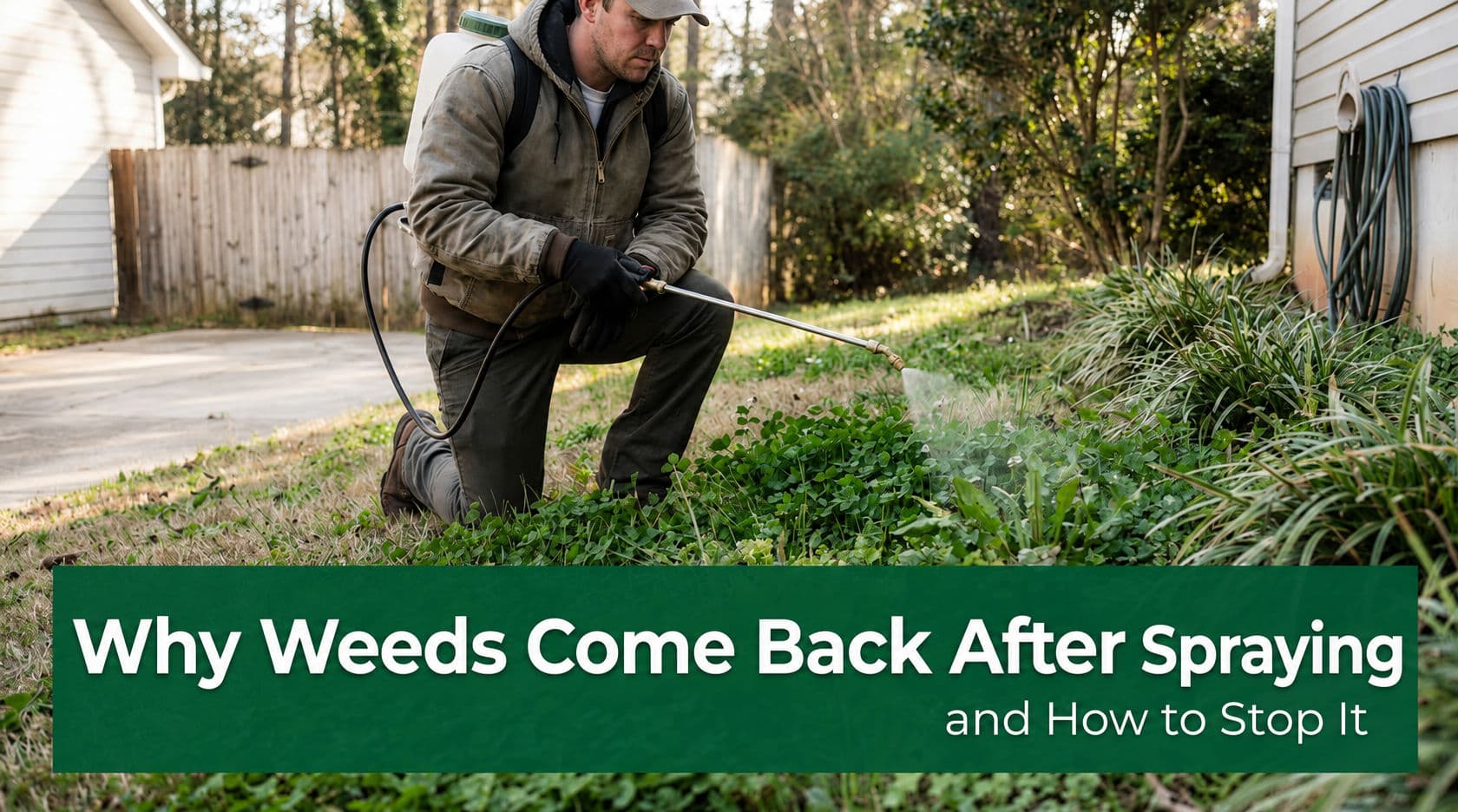
“Why Did My Neighbor’s Weeds Come Back?”
We recently got a call from a longtime customer — let’s call her Linda — who lives on a sloped yard next to a cemetery. We had treated both her yard and her neighbor’s about a month earlier. Linda’s yard looked great: no weeds, just a tiny patch of grass she keeps for the cats.
Her neighbor’s hill, though? Weeds were popping back up already. Same slope, same day of service, same weather. Linda was puzzled, and so were we at first. Why was one yard clean while the other was already seeing green again?
As we talked it through, we ended up explaining something we go over with customers all the time: why weeds sometimes come back after spraying, why sloped yards are trickier, and how to water herbicides in the right way so the treatment actually works.
Why Weeds Come Back After Spraying
When weeds return quickly after a treatment, homeowners usually think one of two things:
- The spray “didn’t work,” or
- The company “missed spots.”
Sometimes that can be the case, but in situations like Linda’s, where her yard is clean and the neighbor’s isn’t, another factor almost always jumps to the top of the list: the herbicide didn’t get watered in properly.
Most pre-emergent weed controls (the ones that stop new weeds from sprouting) need water to move the product off the surface and into the top layer of soil. If that doesn’t happen, the product just sits there, and new weed seeds can still germinate underneath.
Common Reasons Weeds Reappear
From our field experience, here are the most common reasons weeds show back up soon after a spray:
- Herbicide wasn’t watered in (or not enough) within the recommended time.
- Uneven watering, especially on slopes where water runs off before soaking in.
- Heavy foot traffic or pets disturbing the treated surface and soil barrier.
- New weed seeds blowing in from surrounding areas, especially on open hillsides.
- Existing, mature weeds not fully controlled if a post-emergent wasn’t used or they were too large.
In Linda’s case, the key difference was clear: her yard was flat and evenly watered, while her neighbor’s was a steep slope where water tended to run off.
Why Sloped Yards Are Tougher on Weed Control
Sloped yards are beautiful, but from a weed-control standpoint, they can be a real challenge. When we treat slopes, we always stress how important the first watering is, because gravity is working against us.
Here’s what tends to happen on a hill:
- You water from the top or with sprinklers.
- The water starts to move downhill before it has time to soak in.
- The herbicide doesn’t fully penetrate the soil where it needs to be.
- Some areas near the top or middle end up under-watered, and weed seeds in those dry pockets can still sprout.
Linda’s neighbor also loves to grow flowers as a hobby. That can complicate things, too, because:
- Landscape beds often get hand-watered inconsistently.
- People sometimes avoid watering right after a spray because they’re worried about their plants.
- They might water lightly at first, which isn’t enough to activate the product on a slope.
Meanwhile, Linda followed our watering instructions closely on her own yard, which helped lock that barrier into the soil. Same treatment, different watering — very different results.
How to Water Herbicides In Properly
When we finish a weed control application, we always give watering directions. For most pre-emergent products, the general rule is:
- Water within 24–72 hours after the application (check your specific instructions).
- Aim for about ½ to 1 inch of water to move the product into the top layer of soil.
But how you water matters just as much as how much you water, especially on slopes.
Best Watering Practices for Flat Areas
On relatively flat ground, things are more forgiving. We usually recommend:
- Using your existing sprinkler system for a single, thorough cycle.
- Or using a hose-end sprinkler and letting it run long enough to get the top 1–2 inches of soil moist.
- Checking random spots by digging a small hole to confirm moisture made it below the surface.
As long as the water soaks in instead of puddling or running off, you’re helping the herbicide do its job.
Best Watering Practices for Sloped Yards
On slopes like Linda’s neighbor’s hill, we suggest homeowners water more strategically:
- Use short, repeated cycles instead of one long watering. For example, three 10-minute cycles spaced 20–30 minutes apart.
- Start watering from the bottom zone first if you have multiple zones, so water doesn’t immediately run off dry, hard soil below.
- Watch for runoff. If water starts to move downhill before the end of the cycle, shorten the run time.
- Hand-water problem spots (dry patches or steeper sections) to be sure they get enough moisture.
This gives the soil time to absorb the water and carry the herbicide down a couple of inches, where it can create a consistent barrier against germinating weeds.
Watering Around Flowers and Other Plants
Another concern we hear, especially from plant lovers like Linda’s neighbor, is: “Will watering this in hurt my flowers?” The answer depends on the product and the plants, but there are some general tips:
- Follow the product label and our instructions about where we applied the herbicide.
- Keep water directed to soil, not spraying directly on leaves of sensitive ornamentals.
- If you’re worried, hand-water carefully between plants, focusing on the bare soil where weeds normally pop up.
- Let us know if you have newly installed plants or specialty varieties so we can adjust where and how we treat.
In Linda’s neighbor’s case, she was watering “all the time,” but not necessarily in the way that helps a pre-emergent work on that hill. Frequent, light watering on a slope can still leave parts of the soil too dry to activate the product.
What We Do When Weeds Still Come Back
Even with good instructions and best practices, weeds can still sneak through. That’s why, when Linda called us, we told her neighbor we’d come back out and re-spray the weeds on the hill. We stand behind our work, and we know slopes can be stubborn.
When we revisit a property with weed breakthrough, we usually:
- Walk the yard and note where weeds are returning (slope vs. flat, sun vs. shade).
- Ask how and when the area was watered after the first treatment.
- Re-treat the problem spots with the appropriate product (pre-emergent, post-emergent, or both).
- Give updated, specific watering instructions based on what we’re seeing.
That combination of product and proper watering almost always solves the issue the second time around.
Need Help Keeping Weeds Off Your Hill?
If you’ve ever wondered why your neighbor’s yard is weed-free while yours keeps sprouting green, you’re not alone. In many cases, the difference isn’t the product — it’s how it’s watered in, especially on sloped or tricky areas.
If you’re dealing with recurring weeds on a hill, rocky slope, or around flower beds, we’re happy to take a look, explain what’s going on, and put together a plan that actually works for your yard. With the right treatment and watering habits, you really can get to that “nothing left to pull” stage Linda enjoys.